
How to Find Dane County Arrest Records
The fastest way to find a recent Dane County arrest is the Sheriff's current resident roster. It lists people in county jail custody right now, with a name, a judicial status, and a link to a booking detail page. Dane County uses the word "resident" for people in custody, though most searchers call this an arrest or inmate search. The roster is free and needs no login.
Arrest data and court data come from different places. The roster tells you about the current jail booking. The court case, with charges and outcomes, shows up later on Wisconsin Circuit Court Access. A new arrest may not have a court case number yet.
- Open the Sheriff's Current Residents roster.
- Type a last name in the search box to filter the list.
- Open the Detail link for the person.
- Read the booking number, booking date, arrest agency, and offense.
- Search the name later on WCCA for the filed court case.
Full roster fields and visitation rules are on the Dane County inmate records page.
The Dane County Sheriff and Booking Process
The Dane County Sheriff's Office runs the county jail and the arrest roster. When a person is arrested for a crime, they are taken to the Dane County Jail and booked. A judge or court commissioner then sets bail. The judge may allow a signature bond, which is a promise to appear, or require a cash bond. A person who cannot post cash bail stays in jail until the case moves forward.
The Sheriff's website is the hub for the roster, warrants, bail, and visitation.
The Dane County Sheriff's Office homepage links to the jail, the resident roster, and bail information. Bail rules for misdemeanors come from state law.
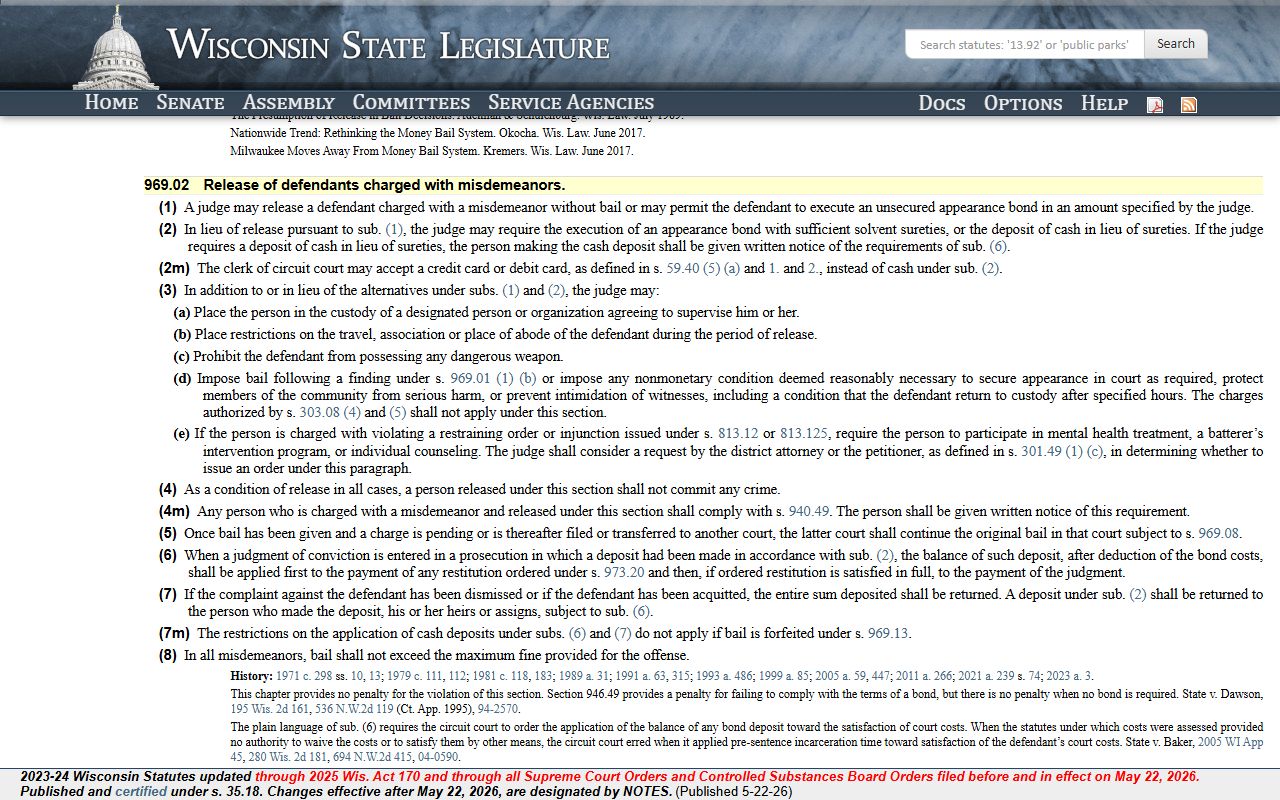
Misdemeanor bail is governed by Wis. Stat. § 969.02. Time spent in jail before sentencing is credited against any sentence later imposed.
What Dane County Arrest Records Show
A booking detail page holds a clear set of fields. It shows the person's name, status, building, and housing area, plus a booking number and booking date. It also shows arrest information: the arrest number, arrest date, the agency that made the arrest, an agency case number, and the offense. The arresting agency is often a city police department, not the Sheriff. That agency holds the actual incident report.
| Field | What It Shows |
|---|---|
| Name and status | The resident's name and judicial status. |
| Booking number | Ties to the current jail booking or stay. |
| Booking date | When the person was booked into the jail. |
| Arrest agency | The department that made the arrest, such as a city police force. |
| Offense | The alleged offense and the number of counts. |
| Court case number | May be blank right after arrest; appears once the case is filed. |
The detail page separates a booking number from a name number. The booking number is tied to the current jail stay, while the name number appears to identify the person in the Sheriff's system. Do not carry a name number into WCCA, because the court system searches by case number, party name, citation, and similar court fields. The two systems use different keys.
Note: A booking detail is not a full criminal history, so use WCCA for the filed case and its charges and outcome.
Arrest Record Versus Criminal Court Record
These two records answer different questions. An arrest record shows a booking event held by the Sheriff. A criminal court record shows the case once prosecutors file it and the court opens it. The comparison below lays out the split.
| Arrest Record | Criminal Court Record |
|---|---|
| Held by the Sheriff's Office | Held by the Clerk of Circuit Court |
| Shows booking and current custody | Shows charges, pleas, and sentencing |
| Found on the jail roster | Found on WCCA |
| May exist before charges are filed | Exists after the case is filed |
For the full case history, see the Dane County court records page.
Charges Versus Convictions
An arrest or a charge is only an allegation. A conviction is a finding or plea of guilt. People often confuse the two, but they carry very different weight. A person can be arrested and never charged, or charged and later cleared. Reading a record the right way matters.
| Charge | Conviction |
|---|---|
| An accusation by the state | A guilty finding or plea |
| Can be dropped or dismissed | Becomes part of the judgment |
| Listed on the booking and complaint | Listed in the disposition and sentence |
Mugshots may or may not appear on a Dane County booking page. The public sample reviewed did not show a mugshot, so do not assume every record has one. A booking image may appear when the system has one.
Dane County's downtown court area is unusually compact. The courthouse, the Public Safety Building jail, the City-County Building jail, the District Attorney, the State Public Defender, and Pretrial Services all sit within a few blocks near Capitol Square. A person with a criminal matter may deal with a city police force, the county jail, the Circuit Court, the DA, and a defense lawyer in the same downtown area. That closeness can make it easier to track a case from arrest through booking, charging, and the first court date.
Public Access and Restricted Arrest Records
Wisconsin treats most court and arrest records as open, but some are closed. Juvenile records are restricted by statute. Sealed records are closed by court order. Mental-health and treatment records are confidential. Records of certain serious offenses also feed a public registry. The sex offender registry is one example, drawn from a separate state law.
That registry comes from a specific statute on offender information and public access.
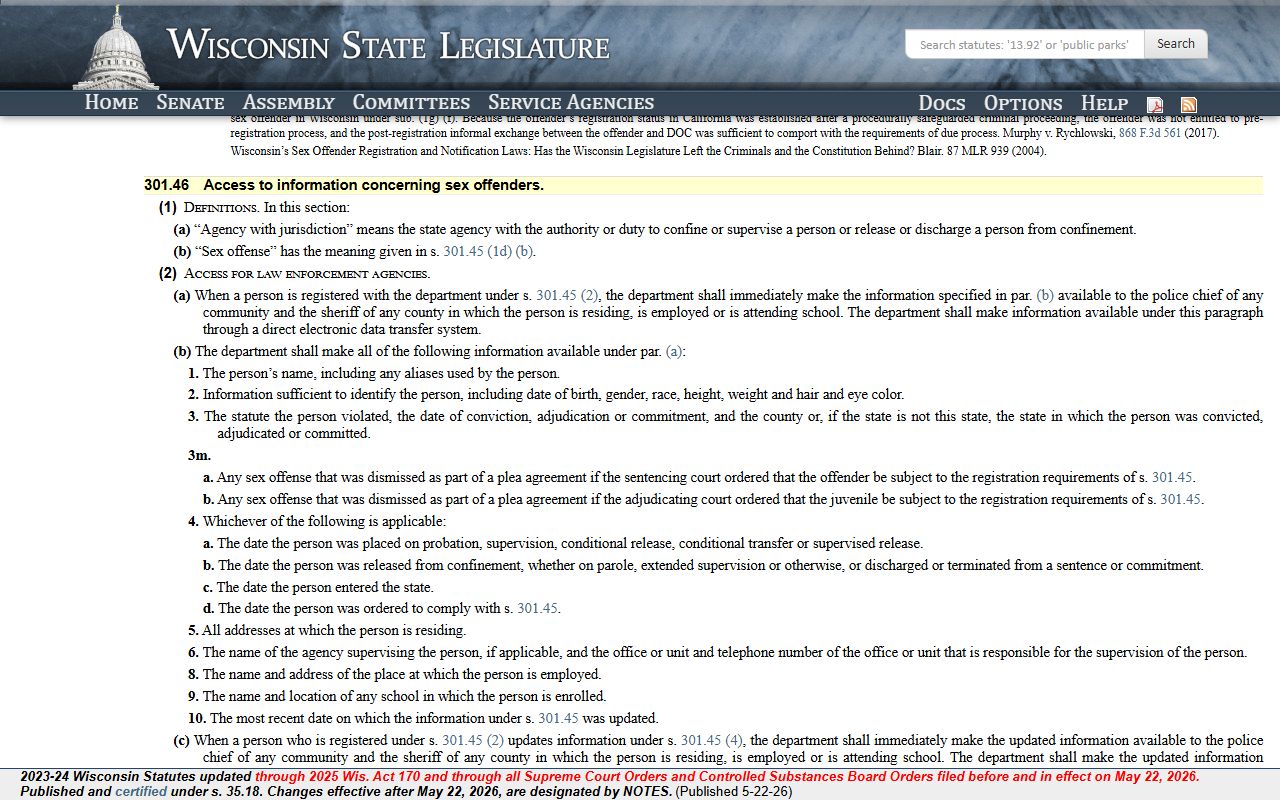
Public access to sex offender registration data comes from Wis. Stat. § 301.46. A background check that uses these records for credit, employment, or housing must follow federal law.
Sealed Versus Expunged Records in Wisconsin
People often ask how to clear an old record. Wisconsin uses two different tools, and neither works like a simple delete. Sealing closes a record from public view by court order. Expungement, under state law, removes a qualifying court record after a sentence is completed, and it is usually decided at sentencing for youthful offenders.
| Sealed | Expunged |
|---|---|
| Closed by court order | Removed under Wis. Stat. § 973.015 |
| Record still exists but is hidden | Court record may be taken out of public view |
| Needs a legal basis and a motion | Tied to eligibility set at sentencing |
Expungement does not erase every agency file. Law-enforcement and corrections history may remain.
The Dane County District Attorney
The Dane County District Attorney prosecutes adult crimes and juvenile delinquency in the county. The office is led by District Attorney Ismael R. Ozanne. It handles about 13,000 cases a year, from civil traffic offenses to homicides, with attorneys, victim-witness advocates, investigators, and support staff. The DA decides whether to file charges after an arrest.
The DA's homepage describes the office mission and caseload.
The Dane County District Attorney site explains the office's role. The DA also runs a Victim Witness Unit and posts a contact page for the public.
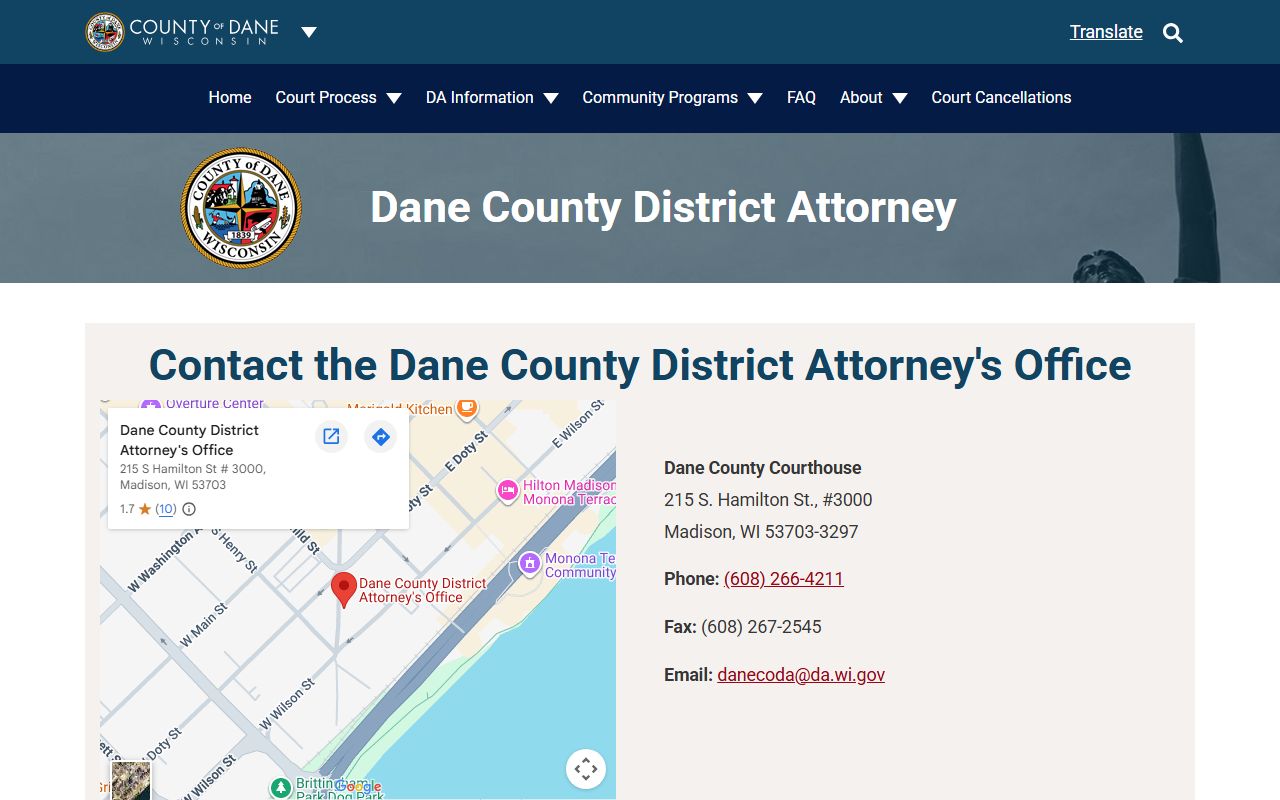
The DA contact page lists how to reach the office and the Victim Witness Unit.
If You Cannot Afford an Attorney
A person who is arrested and cannot afford a lawyer may qualify for the Wisconsin State Public Defender. The SPD screens for financial eligibility and case type. Applying early matters, because waiting until the court date leaves little time to prepare. If the SPD cannot take a case due to a conflict, private appointed counsel may be assigned.
The State Public Defender lists its offices, including the Madison trial office.
The Wisconsin State Public Defender office locations page covers the Madison area. The Dane County Law Library can help with forms but cannot give legal advice. A person who is arrested should apply for the public defender promptly, because waiting until the court date can leave too little time for screening and attorney preparation.
Why a Name May Not Appear on the Roster
A blank result on the jail roster does not prove a person was never arrested. The roster shows current Dane County Jail custody at the moment it loads, and that picture changes all day. A person may have been released on bond, booked and released before you looked, or moved to another setting. The roster is a snapshot, not a history.
Several paths explain a missing name. The person may have transferred to another county, moved into Wisconsin Department of Corrections custody after sentencing, gone into federal custody, or been listed under a different spelling. A juvenile or sealed matter may not appear at all. If the first search fails, try the last name only or an alternate spelling, then check the court case on WCCA. For people who have left county custody, the released inmates page explains how to confirm status through state and federal locators.