
How to Search Dane County Warrants
The Dane County Sheriff's Office publishes an active warrants page. The page loads warrant data into a table and posts a daily-update disclaimer. It states the information is for personal, non-commercial use and that changes in circumstances may affect accuracy. The Sheriff and Dane County assume no responsibility for errors or omissions. For the most current status, the page points users to the DCSO Warrants Division at (608) 284-6110 during normal business hours. That phone line is the official way to confirm whether an order is still open.
A warrant search is not a substitute for a court search. The Sheriff's page tells you whether an order is listed, while Wisconsin Circuit Court Access shows the case behind a bench warrant: the charge, the missed hearing, the bond, and the next court date. Many people need both. Run the warrant page first, then look up the case to learn what the court expects next.
The active warrants page is the official online starting point.
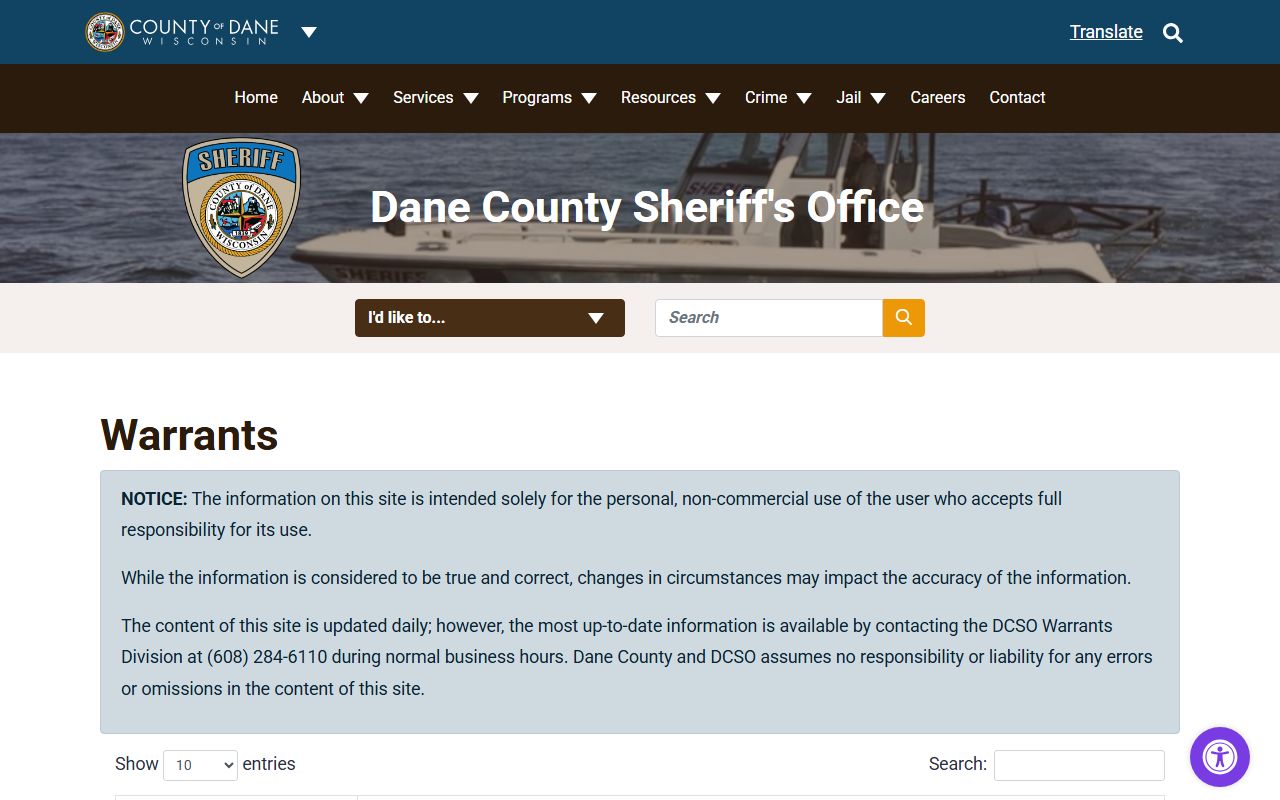
The Dane County active warrants page shows the warrant data and the update disclaimer. Use these steps to check a warrant:
- Open the Sheriff's active warrants page and let the data table load.
- Use the table search or filter to look for a name.
- Read the daily-update disclaimer before relying on a result.
- Call the Warrants Division at (608) 284-6110 to confirm current status.
- Search WCCA for the related case number and any missed hearing.
- Talk to a lawyer before you go to the courthouse if arrest is a risk.
Dane County Warrant Search Controls
The active warrants page is a dynamic tool. A static view of the page shows a loading message and the disclaimer, while the live page renders a data table with search controls. The exact columns can change because the data is loaded fresh each time. The table below lists the controls and notices the page provides, so you know what to expect before you open it.
| Field / Control | Type | Notes |
|---|---|---|
| Active warrants table | Dynamic table | Loads warrant data when the page renders. |
| Search / filter | Table search | Filters rows by name on the live page. |
| Disclaimer | Notice | Daily update; call for the most current data. |
| Warrants Division phone | Phone | (608) 284-6110 during business hours. |
Because the page is for personal, non-commercial use, do not treat it as a screening tool for hiring or housing. Those uses fall under federal law and need a different, compliant source. The Sheriff's list is meant to help people learn about an order and act on it.
Types of Warrants in Dane County
Not all warrants are the same. The kind of warrant tells you how it came to be and how to clear it. Some come from a missed court date, and some come from a new charge. A bench warrant, for example, is the common result when a person fails to appear or breaks a release condition. An arrest warrant flows from a charge and lets law enforcement take a person into custody. Knowing the type helps you plan the right next step.
- Arrest warrant - lets law enforcement arrest a named person.
- Bench warrant - often issued after a failure to appear, a broken bond condition, or contempt.
- Probation or parole hold - shows on the jail roster as a P/P Violation hold rather than a new court warrant.
- Body attachment - can arise in civil, family, or support cases.
- Search warrant - allows a search of a place, person, or property, and is often sealed until executed.
- Out-of-county hold - a person held in Dane County for another jurisdiction.
A search warrant may stay sealed before it is carried out, so it will not appear on a public list. A probation or parole hold is also different from a court warrant. It points to a supervision issue, and it can keep a person in custody even when no new charge has been filed.
- Failure to appear
- Missing a required court date, which often triggers a bench warrant.
- Capias
- A warrant-like order to bring a person before the court; Wisconsin pages more often use warrant language.
- Recall
- A court order that cancels a warrant once the person appears or the issue is resolved.
What a Dane County Warrant Record Shows
A warrant record points to a person and a court matter. While the Sheriff's live table controls the exact columns, a warrant and its related court case generally carry the fields below. The court case on WCCA fills in much of the detail behind a bench warrant, including the charge and the hearing that was missed. Read both together for the full picture.
| Field | What It Shows |
|---|---|
| Name | The person named in the warrant. |
| Warrant type | Arrest, bench, or hold, where listed. |
| Case number | Links to the related court case on WCCA. |
| Charge or reason | The offense or the missed hearing behind the order. |
| Issuing court | The court that signed the warrant. |
| Status | Whether the warrant is active; confirm by phone. |
WCCA may show the docket event tied to a warrant, such as the order that issued it, but it does not show law-enforcement execution details. For those, the Sheriff's records and the arresting agency are the proper sources.
How to Resolve an Outstanding Warrant
An open warrant does not go away on its own. The safer path is to confirm it, learn the case behind it, and get legal help before any arrest. Acting on online data alone is risky when arrest is possible, because the listing may be a day behind. A short call and a quick case lookup put you on firmer ground.
- Confirm the warrant on the Dane County active warrants page, then call the Warrants Division at (608) 284-6110 for current status.
- Search WCCA for the case number, court, charge, and any missed hearing.
- Contact a criminal defense attorney or the Wisconsin State Public Defender if eligible.
- If bond is allowed, confirm the amount and the posting method.
- Appear in court as directed, or arrange a voluntary surrender if advised.
- After the court clears the warrant, allow time for databases to update and confirm the change.
A warrant tied to a missed traffic or forfeiture matter may clear differently from one tied to a felony. Check the case type in WCCA so you know which court and which path applies. The traffic court records page covers tickets, while the arrest records page covers booking after a custody arrest.
Watch out for warrant scams. In one Dane County alert, a caller posed as a sergeant and asked family members for fees tied to ankle monitoring, claiming release paperwork was done. The Sheriff's Office warned that it does not call families asking for fees to release someone on a jail diversion program, and it does not offer electronic monitoring for people who are not sentenced. If you get a call like that about a Dane County warrant or release, do not pay, and confirm directly with the Sheriff's Office.
Bond and Release After a Warrant Arrest
When a person is arrested on a warrant, they are taken to the Dane County Jail and booked. A judge or court commissioner then sets bail. The judge may allow a signature bond, which is a written promise to appear, or require a cash bond. A person who cannot post cash bail stays in jail while the case moves forward. Time spent in custody before sentencing is credited against any sentence later imposed.
Bail can be posted in person at the Bail and Release window in the Public Safety Building, 115 West Doty Street, first floor, or online through GovPayNow using the booking number and Pay Location Code 1157. A 5% nonrefundable fee applies to card payments. Release is not always quick, because holds, no-contact orders, other warrants, or court conditions can delay it even after money is posted.
Release on a signature bond comes with rules. The Dane County bond conditions ask a person to appear at every noticed court date, obey court orders, commit no new crimes, and give written notice of any address change to the Clerk of Courts within 48 hours. Breaking a condition can lead to a new bench warrant, so the conditions matter as much as the bail amount. The released inmates page explains bond returns and custody checks in more detail.
Limits of Dane County Warrant Data
Online warrant lists have gaps. Active data may lag the daily update, so a cleared order can linger and a new one may not show yet. Sealed warrants may not appear before an arrest. Juvenile warrants and records may be restricted by law. A clear search result is not a promise that no order exists, which is why the phone confirmation matters.
Note: Because warrant data can change quickly, call the Warrants Division at (608) 284-6110 to confirm status before you rely on any online result.