
How to Search Dane County Probate Records
Probate cases carry the case-type code PR and appear in Wisconsin Circuit Court Access like other circuit court matters. Search by party name and select Dane County to find a probate case summary. As with other case types, WCCA shows the summary and docket, not the full set of documents. For actual records, certified copies, or older files, you contact the court.
Probate records requests go to the court records email used by the Record Center. The Probate Office also routes work by subject, with one email for probate and estate matters and a separate email for guardianship matters. A search without a case number carries a small probate search fee, so it helps to find the case number first.
Most probate files are open to the public, but not all. Probate records may be public unless a court seals them or a statute makes them confidential. Estate files tend to be open, while guardianship and protective placement files can hold confidential medical and capacity information. When you request a record, give the decedent's or ward's full name, the case number if you have it, and the exact documents you want, such as a will, an inventory, or a final account.
The Dane County Probate Office
The Probate Office sits in Room 1005 of the Dane County Courthouse. The Register in Probate is Jeff Okazaki, and the office is staffed by a probate paralegal, a guardianship administrator, and probate registrars. Appointments are encouraged, and the office keeps the same weekday hours as the rest of the courthouse.
The official probate page lists the office contact details, the probate types, and the statutory fees.
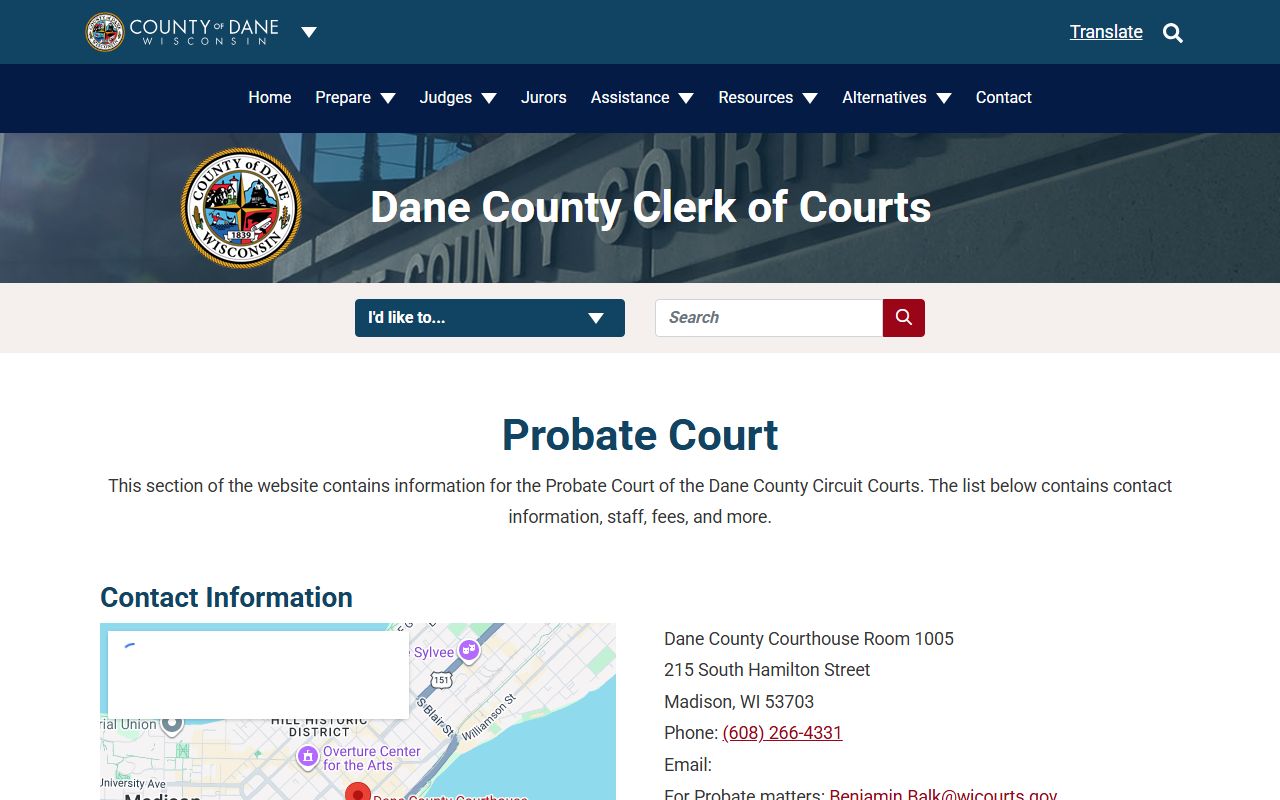
The Dane County Probate page covers the office, its staff, and the fee list. Contact details are below.
Probate Office / Register in Probate
Dane County Courthouse, Room 1005
215 S Hamilton St
Madison, WI 53703
(608) 266-4331
Mon–Fri 7:45 AM–4:30 PM
Guardianship and Records Contacts
Guardianship matters
Gina.Bosben@wicourts.gov
Probate records requests
Dane.courtrecords@wicourts.gov
Types of Dane County Probate Matters
Dane County probate covers a wide range of matters. The right type depends on the size of the estate, whether a will exists, and what relief is needed. The Probate Office lists these categories, and the forms page sorts blank forms by them.
- Informal and formal probate of estates
- Ancillary administration and special administration
- Summary assignment and summary settlement
- Transfer by affidavit, extension, and proof of will
- Guardianship and conservatorship
- Trusts and trust matters
- Will safekeeping and health-care power of attorney safekeeping
Picking the right category first saves wasted effort. A small estate may qualify for summary assignment or transfer by affidavit, while a larger estate may need formal probate. The Probate page checklists are the practical starting point.
Informal and formal probate are the two main paths for an estate. Informal probate is handled largely through the Register in Probate with less court supervision, and it suits estates where no one expects a dispute. Formal probate involves more direct court oversight and is used when a will is contested, when title questions arise, or when an interested person asks for it. Ancillary administration handles property in Wisconsin when the main estate is in another state, and special administration covers urgent steps before a full case is open.
Probate Terms Defined
Probate uses words that rarely come up in daily life, and the same term can mean different things in another state. A short glossary helps when reading a Dane County probate file or a form.
- Testator
- A person who makes a will.
- Executor
- The person named to carry out a will, also called a personal representative.
- Intestate
- Dying without a valid will, so state law decides who inherits.
- Guardianship
- A court appointment to make decisions for a person who cannot.
- Conservatorship
- A court appointment to manage another person's money or property.
- Personal representative
- The person who administers an estate, gathers assets, pays claims, and distributes property.
- Transfer by affidavit
- A simple way to pass a small estate without full probate when the value is low enough.
Probate Filing and Record Fees
Probate fees are set by statute and listed on the Dane County Probate page. Many are tied to the value of the estate or the type of filing. The schedule below shows the main charges.
| Item | Fee |
|---|---|
| Inventory filing, estate $10,000 or less | $20 |
| Inventory filing, estate over $10,000 | 0.2% of value subject to administration |
| Guardianship or conservatorship under $50,000 | $20 |
| Will safekeeping | $10 |
| Copies | $1 per page |
| Search when case number not given | $4 |
| Health-care POA safekeeping | $8 |
These fees come from Wis. Stat. § 814.66. A search without a case number adds the $4 fee, so look up the number on WCCA first when you can. The inventory fee on a larger estate is set at 0.2% of the value subject to administration, less encumbrances, liens, and charges, so the exact amount depends on the estate. A declaration for safekeeping is $8, and a petition for grandparent visitation as an independent action is $60. Because these are statutory, they apply the same way across Wisconsin counties, not just in Dane County.
Will Safekeeping in Dane County
A testator may deposit a will for safekeeping with the Register in Probate in the county where the testator lives. The fee is $10. The will must be in a sealed envelope with the testator's name and address on the outside, and a self-addressed stamped envelope is submitted for the receipt. To withdraw the original will, the testator needs the original receipt and a photo ID.
Only the testator can remove the original will in person, or an authorized person with a writing signed by the testator and two witnesses other than the person withdrawing it. The forms page links the safekeeping and related probate forms.
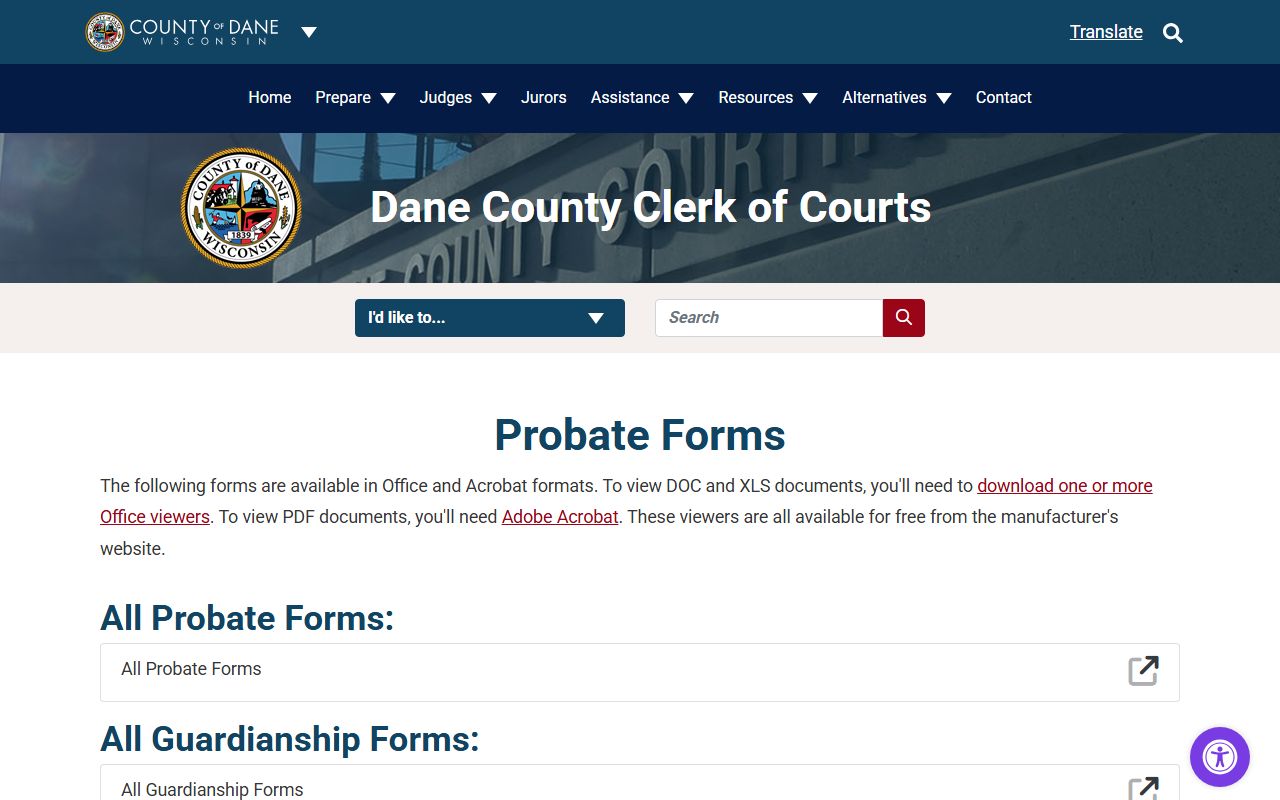
The probate forms page lists probate, guardianship, trust, and personal representative resources. Many are Wisconsin mandatory forms.
Safekeeping is a small but useful service. Depositing a will with the Register in Probate keeps the original safe and easy to find after death, which can prevent a lost-will dispute. The same office also accepts a health-care power of attorney and a declaration for safekeeping, each for a modest statutory fee. These are not the same as filing a probate case; they simply store an original document with the court until it is needed.
How Probate Works in Dane County
Probate follows a clear order once the right type is chosen. The steps below outline a typical estate, though guardianship and trust matters differ. The personal representative does much of the work, with the court and the Register in Probate checking that notices, inventories, and accounts are filed on time.
- Identify the probate type, such as informal, formal, summary, or transfer by affidavit.
- Review the Dane County Probate page checklists and forms.
- File the correct petition and required documents with the Register in Probate.
- Pay the statutory filing, inventory, search, and copy fees.
- Give required notices to heirs, interested persons, and creditors.
- Handle inventory, claims, asset management, taxes, and distribution.
- File the inventory, account, and final documents to close the estate.
Guardianship and Conservatorship Records
Guardianship and protective placement records can hold confidential medical and capacity information. Even where some docket events are public, the medical detail behind them may be restricted. That is why the Probate Office routes guardianship questions to a separate email and asks for care with these files.
A conservatorship is a voluntary appointment to manage money or property, while guardianship covers broader decisions for a person who cannot make them. Both run through the Probate Office. For related family and estate matters, see the marriage and divorce records page.
Guardianship cases often pair with protective placement, which decides where a person lives when they cannot safely choose for themselves. These cases include annual reporting, so the file can grow over years with accounts and reviews. The guardianship administrator in the Probate Office is the right contact for questions on annual accounts, reporting deadlines, and the forms a guardian must file. Because of the medical detail involved, expect more limits on public access than with an ordinary estate.