
How to Search Dane County Public Records
Public records in Dane County are spread across several offices. Court case files go through the Clerk of Circuit Court and Wisconsin Circuit Court Access. Deeds and recorded documents go through the Register of Deeds. County board minutes, elections, and marriage licenses sit with the County Clerk. Law-enforcement records belong to the Sheriff or a city police department. The first task is always to match the record to its keeper.
Once you know the office, the request is usually short. For court records, you can find a case on WCCA and then ask the Record Center for documents. For other records, you contact the office that holds them. Anyone can ask, and you do not have to explain why you want a record. The right to access comes from the state Public Records Law, which is covered next.
It also helps to know what kind of record you want before you ask. A court record is a case file, such as a complaint, a judgment, or a docket. A public record in the broader sense can be an email, a contract, a meeting minute, a policy, or a recorded deed held by a government office. The court Record Center handles case files, while a broad open-records request about county business may go to the County Clerk, a department, or the office that created the record. Naming the record clearly is the single biggest thing you can do to get a quick, complete answer in Dane County.
Wisconsin Public Records Law
Wisconsin's open-records framework starts from a strong presumption of access. The declaration of policy states that the public is entitled to the greatest possible information about the affairs of government and the official acts of public officers. Courts read the law with that goal in mind, applying exceptions only where a specific statute or a public-interest harm calls for it. This is the starting point for any Dane County public records request.
The policy statute sets the tone for everything that follows.
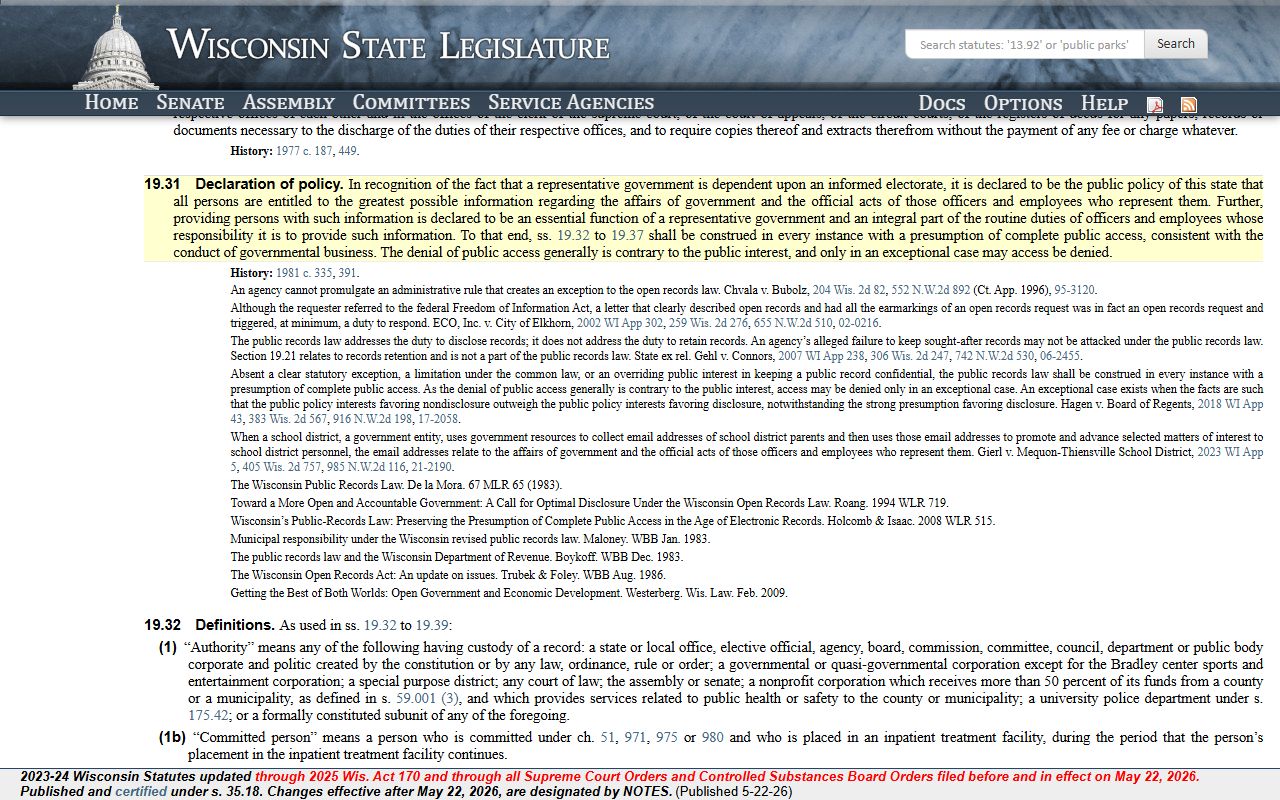
Wis. Stat. § 19.31 declares the open-records policy. It does not list every record; it sets the rule that access is the default and secrecy is the exception, which is why most Dane County records are open.
Your Right to Inspect and Copy
The core access statute gives any requester the right to inspect and copy records, except as otherwise provided by law. It also sets rules on where and when records are available, on copying, on fees, and on prepayment. Fees under the public-records law are limited to the actual, necessary, and direct cost of reproduction and similar tasks, not a profit. Dane County applies a prepayment rule for court-record requests that run over $5.
The access statute is the one most requesters rely on.
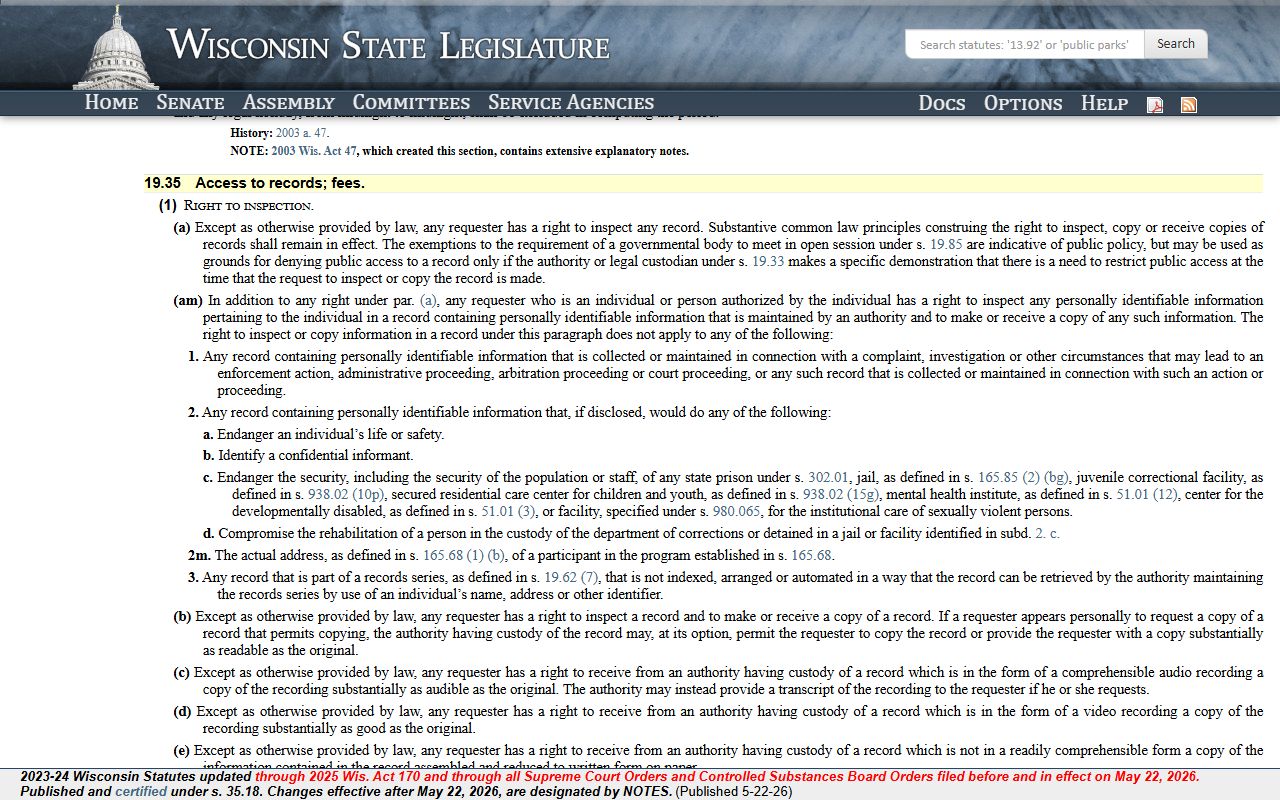
Wis. Stat. § 19.35 covers the right to inspect and copy, along with fee and prepayment authority. Dane County cites its prepayment provision when a record request will cost more than $5.
The same statute shapes how an office must respond. A records custodian is expected to fill a request as soon as practicable and without delay, to help a requester narrow a broad request, and to give a written reason if access is denied in whole or in part. A denial is not the end of the road. The law lets a requester press the matter, and the custodian must point to a specific legal basis rather than a general wish for privacy. That balance, access by default with narrow and stated exceptions, runs through every Dane County public records request.
How to File a Public Records Request
A clear request gets a faster answer. You do not need a special form, but a written request that names the records helps the office find them. For court records, Dane County takes requests in person, by mail, by fax, or by email, and it does not take requests by phone.
- Identify the office that holds the record, such as the Clerk of Circuit Court or the Register of Deeds.
- Describe the records as exactly as you can, with names, dates, and case numbers.
- Send the request by an accepted method for that office.
- Include your name, a phone number, and a mailing address for the response.
- Pay any required fee, and prepay when the cost will exceed $5.
- Allow time for older or off-site records to be retrieved.
For court records, the Record Center asks for the full name, any other names a case could be under, the case number if known, and the exact documents wanted. A date of birth helps for criminal searches. If staff must pull an older file from remote storage, the response can take several days, so build that into your timing.
Public Records Request Fields
While there is no single statewide form, a court-record request works best when it includes the fields below. Giving a case number is the single best way to speed a request and avoid a search fee.
| Field | Required | Notes |
|---|---|---|
| Full name | Yes | Include any other names the case could be filed under. |
| Phone number | Requested | For staff to reach you; phone requests are not accepted. |
| Current address | Yes | Used to mail records or an invoice. |
| Case number | Recommended | Avoids the $5 staff search fee. |
| Date of birth | For criminal searches | Helps tell apart similar names. |
| Documents requested | Yes | Name the exact items, such as a judgment or order. |
Fees for Dane County Public Records
Inspection of a non-confidential record is free. Copies carry set fees, and a staff search without a case number adds a per-name charge. The court fee schedule below covers the common items, and prepayment is required when a request tops $5.
| Item | Amount |
|---|---|
| Plain copy per page | $1.25 |
| Certified copy | $5 per document |
| Staff search without case number | $5 per name |
| Postage | Actual cost |
Other offices set their own copy fees within the limits of the open-records law. The Register of Deeds, for example, charges recording and copy fees for deeds and vital records. Always ask the holding office for its current fee before you send payment, and ask whether prepayment is required so the request is not held up.
Limits on Access
Open access is the rule, but it is not absolute. One statute lists the categories where other law limits public access, including certain law-enforcement records, some contractor records, and records made confidential elsewhere. This is why an open court file does not mean every court-adjacent record is public.
The limits statute explains where access narrows.
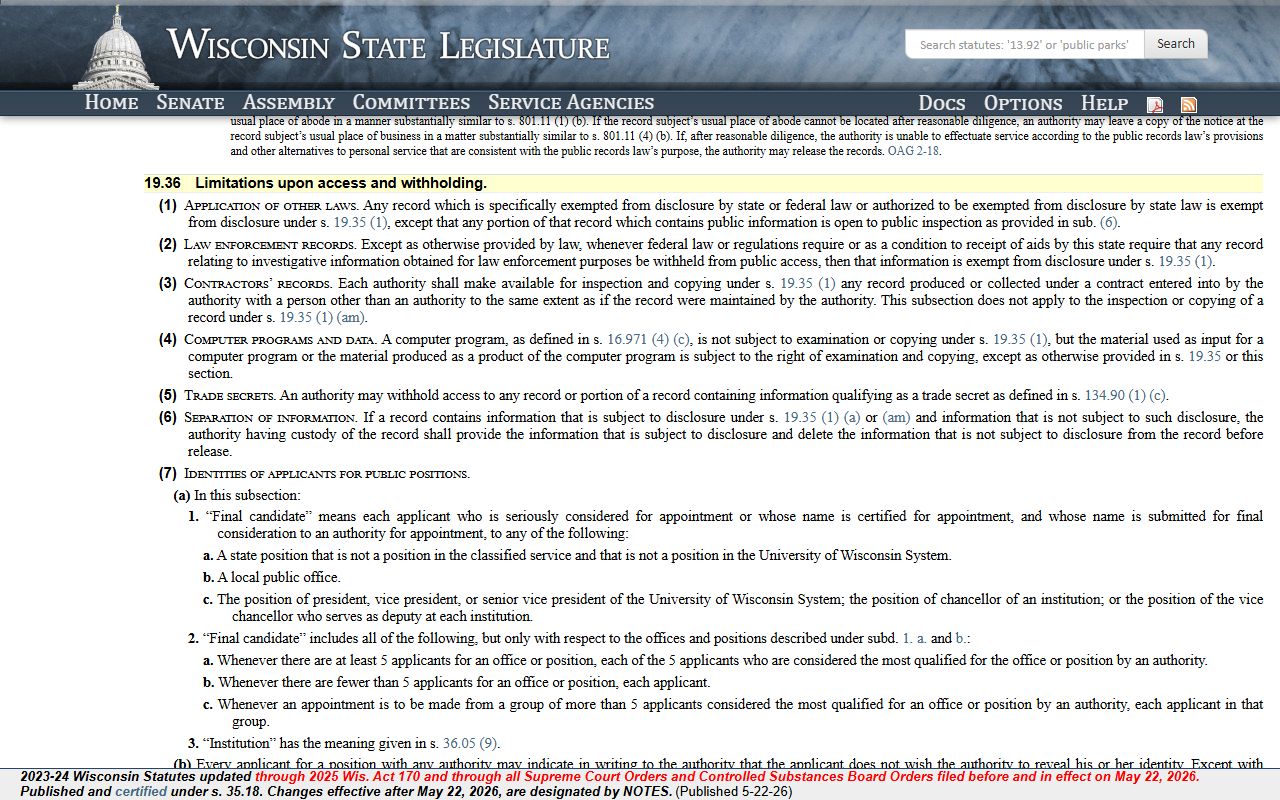
Wis. Stat. § 19.36 identifies where access is limited by other law. When a request is wrongly denied, a separate statute provides a remedy.
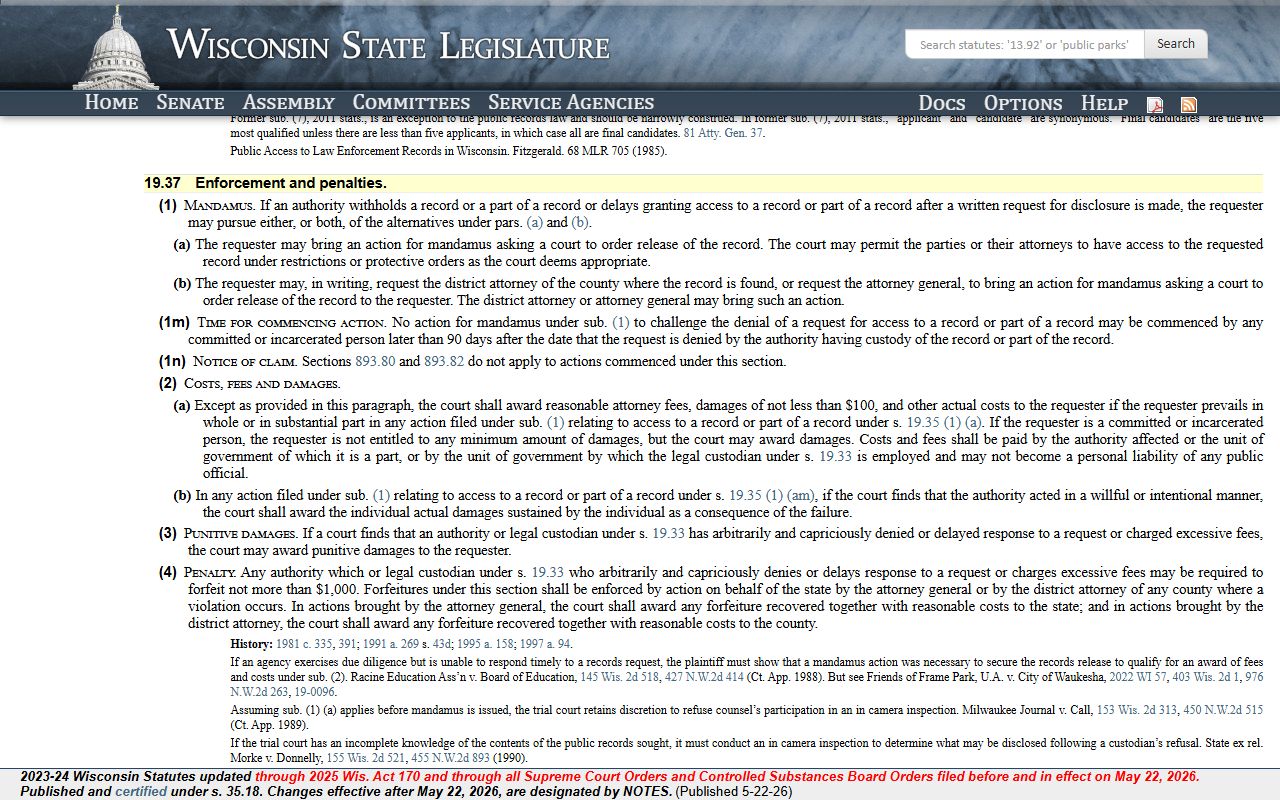
Wis. Stat. § 19.37 lets a requester ask a court to order release through mandamus, and it allows damages and attorney fees in proper cases. Most Dane County requests never reach that point, but the path exists.
What the County Clerk and Register of Deeds Keep
Court files are only part of the public record. The Dane County County Clerk handles county board records, elections, and marriage licenses. The Register of Deeds records deeds, mortgages, and other property documents, and it keeps vital-record certificates for births, deaths, marriages, and divorces that occurred in Dane County. These offices are separate from the Clerk of Circuit Court, which holds the court case files.
Matching the record to the office saves time. A property title question goes to the Register of Deeds, a marriage license goes to the County Clerk, and a lawsuit goes to the Clerk of Circuit Court. The County Clerk page and the Clerk of Circuit Court page explain each office in detail.
State agencies add another layer in Dane County, because Madison is the state capital. Many state offices, boards, and the courts themselves sit downtown, so a record about state government may belong to a state agency rather than the county. When a record involves a state program, an election dispute, or a statewide office, the request may go to that agency under the same open-records law. The principle stays the same across all of them: identify the office, describe the record, and send the request the way that office accepts.